OEM vs ODM for Clothing Startups: Which Should You Choose?
If you’re launching a clothing startup, ODM is usually the better choice for faster market entry and lower upfront costs, while OEM is better for building unique products and long-term brand value.
This guide compares both manufacturing models to help you choose the right option for your business.
If you’re new to apparel production, you may also find our guide to the clothing manufacturing process helpful.
Quick Recommendation
Before diving into the details, use this quick reference to identify which manufacturing model best matches your current situation.
| Your Situation | Recommended Choice |
|---|---|
| No product designer | ODM |
| Limited startup budget | ODM |
| Need fast market testing | ODM |
| Want to launch quickly | ODM |
| Have original product designs | OEM |
| Need complete product control | OEM |
| Building a long-term clothing brand | OEM |
| Want unique products | OEM |

OEM vs ODM: Key Differences at a Glance
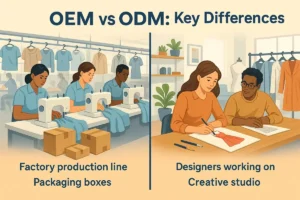
Although OEM and ODM are both widely used in apparel manufacturing, they serve different business objectives. Understanding their differences makes it much easier to choose the right development path for your brand.
| Feature | OEM | ODM |
|---|---|---|
| Product Design | Brand | Manufacturer |
| Development Cost | Higher | Lower |
| MOQ | Usually Higher | Usually Lower |
| Lead Time | Longer | Faster |
| Product Exclusivity | High | Limited |
| Product Customization | Extensive | Moderate |
| Brand Control | Complete | Partial |
| Best For | Long-term brand building | Fast product launch |
Key Takeaway
If your goal is to create original products and build a differentiated clothing brand, OEM is usually the better choice. If your priority is launching products quickly with lower upfront investment, ODM is generally the more practical solution.
Which Option Is Better for Your Clothing Startup?
Choosing the right manufacturing model isn’t about selecting the cheapest option—it’s about choosing the approach that matches your current business stage.
Decision Matrix
| If You... | Choose |
|---|---|
| Have no designer | ODM |
| Have a limited development budget | ODM |
| Need to launch within weeks | ODM |
| Want to validate market demand | ODM |
| Already own product designs | OEM |
| Want complete product ownership | OEM |
| Plan to build a premium clothing brand | OEM |
| Need maximum product flexibility | OEM |
Many successful clothing startups begin with ODM to reduce development risks and later transition to OEM after validating their products and growing their customer base.
What Is OEM?
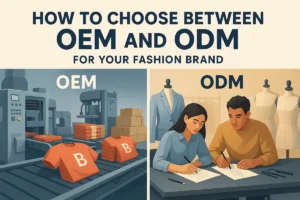
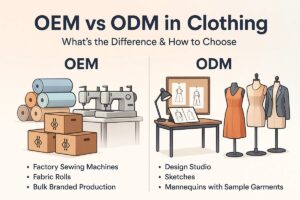
OEM (Original Equipment Manufacturer) is a manufacturing model where the clothing brand provides the product design and specifications, while the factory manufactures garments according to those requirements.
OEM gives brands complete control over product development, customization, quality standards, and brand identity. It is generally the preferred choice for startups that want to develop original products and build long-term competitive advantages.
What Is ODM?
ODM (Original Design Manufacturer) allows brands to select products already developed by the manufacturer and customize selected elements such as labels, fabrics, colors, or packaging.
Because product development has already been completed, ODM usually requires less time and lower development costs, making it an attractive option for startups looking to enter the market quickly.
Pros and Cons of OEM
OEM offers greater flexibility and product uniqueness but requires more planning and investment.
Advantages
- Complete product customization
- Exclusive product development
- Better brand differentiation
- Greater flexibility in materials and trims
- Stronger intellectual property protection
What this means for startups
OEM helps create products that competitors cannot easily copy, allowing brands to establish stronger market positioning and long-term customer loyalty.
Disadvantages
- Higher development costs
- Longer sampling timeline
- More communication during development
- Higher upfront investment
What this means for startups
OEM works best for founders who already understand their customers and have a clear product development strategy.
Pros and Cons of ODM
ODM simplifies product development and helps startups reduce both time and investment.
Advantages
- Faster product launch
- Lower development costs
- Easier product sourcing
- Shorter sampling process
- Lower business risk
What this means for startups
ODM allows founders to focus on marketing, branding, and sales while reducing the complexity of product development.
Disadvantages
- Limited product uniqueness
- Less customization
- Similar products may be sold to multiple brands
- Less control over product development
What this means for startups
ODM is ideal for validating product ideas but may become limiting once your brand requires stronger differentiation.

Real Startup Scenarios
Scenario 1: Launching Your First Clothing Brand
You have limited funding, no in-house designer, and want to launch your first apparel collection quickly.
Recommended Choice: ODM
Choosing factory-developed products reduces development costs and allows you to test market demand faster.
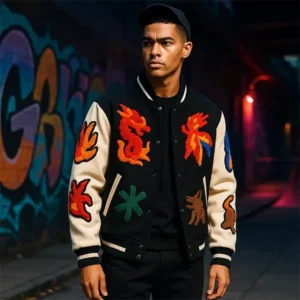
Scenario 2: Building a Premium Streetwear Brand
Your brand has original graphics, custom fits, and a long-term vision for exclusive products.
Recommended Choice: OEM
OEM provides complete control over garment construction, branding, and product quality.
Scenario 3: Expanding Into a New Product Category
Your business already has customers but wants to test a new category before investing heavily.
Recommended Choice: Start with ODM to validate demand, then transition to OEM for successful products.
Common Mistakes When Choosing OEM or ODM
Many startups make manufacturing decisions too early or focus only on production costs.
Common mistakes include:
- Choosing OEM before validating customer demand
- Selecting ODM when product uniqueness is essential
- Ignoring minimum order quantity requirements
- Underestimating sampling and development timelines
- Focusing only on short-term costs instead of long-term brand growth
Avoiding these mistakes helps reduce risk and creates a stronger foundation for future product development.
Final Recommendation
There isn’t a single manufacturing model that fits every clothing startup.
Choose ODM if your goal is to launch products quickly, minimize development costs, and validate your business idea with lower risk.
Choose OEM if your goal is to build a differentiated clothing brand with complete control over product development, quality, and long-term brand value.
If you’re still evaluating which manufacturing model best fits your project, you can contact Mingxing Clothing to discuss your product goals before starting development.
FAQ
Which is better for clothing startups, OEM or ODM?
ODM is generally better for startups that need faster launches with lower development costs, while OEM is more suitable for brands focused on long-term product differentiation.
Can I switch from ODM to OEM later?
Yes. Many successful clothing brands begin with ODM to validate market demand and later transition to OEM as their business grows.
Which manufacturing model usually requires a higher MOQ?
OEM projects often require higher minimum order quantities because products are developed specifically for one brand.
Do I need my own product designs for OEM production?
Yes. OEM manufacturing requires product designs, technical specifications, or tech packs provided by the brand.
Which manufacturing model offers better long-term brand value?
OEM generally provides stronger long-term brand value because it gives brands complete control over product design, customization, quality standards, and brand identity.
Share With
Related Articles
Hot Products