How to Compare Clothing Manufacturer Quotes
Many apparel brands request quotations from several manufacturers and quickly discover that comparing quotes is more difficult than expected.
One factory quotes $8.
Another quotes $10.
A third quotes $12.
At first glance, choosing the cheapest option may seem like the obvious decision.
However, experienced buyers know that the lowest price is not always the best value.
Understanding how to compare clothing manufacturer quotes correctly can help you avoid costly sourcing mistakes and choose the right apparel manufacturing partner for your brand.
Quick Answer: What Should You Compare Besides Price?
When reviewing manufacturer quotations, compare:
- Product capability
- Fabric quality
- Construction details
- MOQ requirements
- Quality control standards
- Lead times
- Communication quality
Price matters.
But price alone rarely tells the full story.
The goal is not to find the cheapest quote.
The goal is to find the best value.
What Most Buyers Compare Wrong
Many buyers compare quotations like this:
| Factory | Price |
|---|---|
| Factory A | $8 |
| Factory B | $10 |
| Factory C | $12 |
Then choose the lowest number.
The problem is that these quotations may not represent the same product.
A better question is:
Are these factories quoting the same specifications, quality standards, and production requirements?
If the answer is no, the comparison is incomplete.
Factory Perspective: Why Comparing Quotes Is Difficult
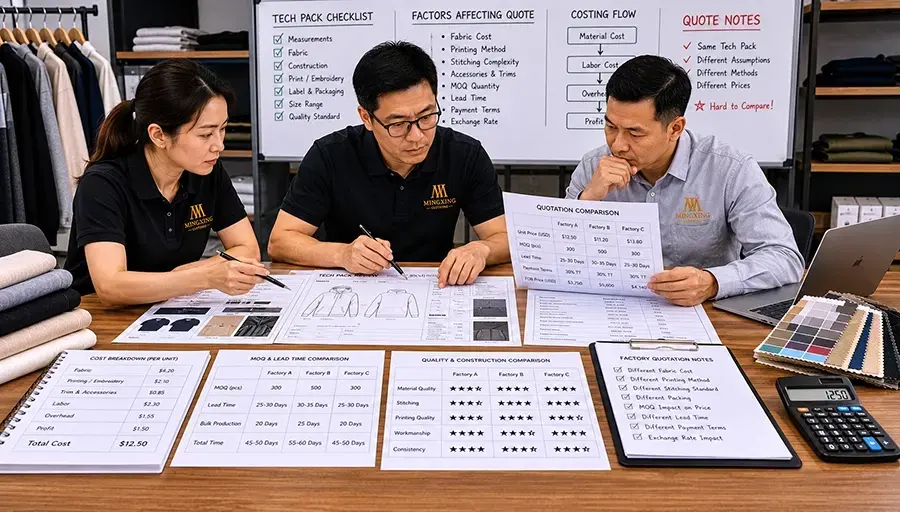
Manufacturers can only quote based on the information they receive.
When project details are incomplete, factories often make different assumptions regarding:
- Fabric quality
- Garment construction
- Printing methods
- Packaging requirements
- Quality standards
As a result, two suppliers may quote very different products without realising it.
This is one reason why accurate quote comparisons require much more than reviewing unit prices.
What Matters Most When Comparing Quotes?
Not every evaluation factor carries the same importance.
| Factor | Importance | Why It Matters |
|---|---|---|
| Product Capability | ⭐⭐⭐⭐⭐ | The factory must be able to produce your product correctly |
| Fabric Quality | ⭐⭐⭐⭐⭐ | The biggest influence on quality and cost |
| Quality Control | ⭐⭐⭐⭐ | Reduces production risk and defects |
| Communication | ⭐⭐⭐⭐ | Prevents misunderstandings and delays |
| MOQ Fit | ⭐⭐⭐⭐ | Affects inventory and cash flow |
| Lead Time | ⭐⭐⭐ | Influences launch schedules |
| Price | ⭐⭐⭐ | Important, but should not drive the entire decision |
Many buyers focus on price first.
Experienced buyers often focus on capability first.
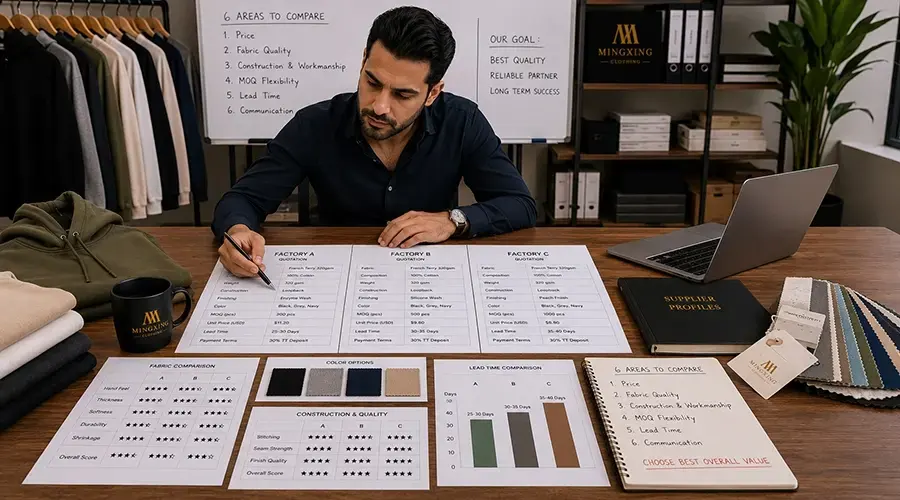
The 6 Areas You Should Compare
Fabric Specifications
Fabric is often the largest cost component in garment manufacturing.
Compare:
- Fabric composition
- Fabric weight (GSM)
- Fabric supplier
- Fabric finishing
- Color requirements
Even small fabric differences can create significant pricing differences.
Construction Details
Construction quality affects durability, appearance, and labour cost.
Examples include:
- Stitch density
- Seam reinforcement
- Panel construction
- Garment washing
- Trims and accessories
Always confirm that construction requirements are comparable.
Printing and Decoration Methods
Compare:
- Screen printing
- Embroidery
- DTF printing
- Puff printing
- Specialty finishes
Different decoration methods can dramatically affect pricing.
MOQ Requirements
MOQ affects both production efficiency and unit pricing.
A factory quoting a low MOQ often charges a higher unit price to compensate for reduced efficiency.
Quality Control Standards
Not all manufacturers inspect products to the same standard.
Compare:
- In-line inspections
- Final inspections
- Measurement checks
- Packaging inspections
Stronger quality systems often reduce long-term risk.
Communication and Lead Time
The best quote is difficult to use if communication is poor.
Compare:
- Response speed
- Technical support
- Sample lead times
- Production lead times
Many brands find that stronger custom clothing manufacturing services create more value than minor price savings.
A Real Quote Comparison Example
Imagine three factories quoting the same custom hoodie project.
Requirements:
- 320gsm cotton hoodie
- Screen print logo
- 100 pieces
| Factory | Price | Key Difference |
|---|---|---|
| Factory A | $8.50 | 280gsm fabric |
| Factory B | $10.20 | 320gsm fabric + stronger QC |
| Factory C | $11.50 | 380gsm fabric + embroidery |
Which quote is best?
There is no universal answer.
A startup brand may choose Factory B.
A premium streetwear brand may choose Factory C.
A budget-focused project may prefer Factory A.
The best quote depends on the product positioning and business goals.
Why the Cheapest Quote Can Cost More Later
One of the most common sourcing mistakes is focusing only on the lowest price.
A factory may save you:
- $1 per piece
- $500 on the order
But create:
- Production delays
- Quality problems
- Rework costs
- Product returns
- Customer complaints
A slightly higher quotation can often reduce overall business risk.
The cheapest quote is not always the lowest-cost decision.
Red Flags in Manufacturer Quotes
Be cautious if a quotation:
- Is dramatically lower than every competitor
- Lacks fabric specifications
- Omits MOQ information
- Avoids discussing quality control
- Cannot explain pricing assumptions
- Changes pricing frequently
- Refuses to discuss sample development
A quotation with missing information is often more risky than a quotation with a higher price.
Manufacturer Quote Scorecard
When comparing suppliers, score each factory from 1–5.
| Evaluation Area | Score (1-5) |
|---|---|
| Product Capability | |
| Fabric Quality | |
| Quality Control | |
| Communication | |
| MOQ Fit | |
| Lead Time | |
| Price Competitiveness |
The highest-scoring supplier is often the best choice, even if they are not the cheapest.
Which Quote Is Actually Better?
The best quotation usually provides the strongest balance between:
- Product quality
- Manufacturing capability
- Communication
- Pricing
- Business fit
The goal is not to find the lowest price.
The goal is to find the supplier most likely to help your product succeed.

Quote Evaluation Checklist
Before choosing a manufacturer, ask:
✓ Are fabric specifications identical?
✓ Are decoration methods the same?
✓ Is MOQ comparable?
✓ Are quality standards clearly defined?
✓ Are lead times realistic?
✓ Does the factory have experience with similar products?
✓ Is communication professional and responsive?
✓ What risks exist beyond the quoted price?
If several answers are unclear, request clarification before making a decision.
Ready to Compare Manufacturer Quotes More Effectively?
Comparing quotations is not about finding the lowest number.
It is about understanding what each manufacturer is actually offering and identifying the supplier that delivers the best overall value.
If you’re reviewing supplier quotations and need help evaluating pricing, MOQ, quality standards, or production requirements, Contact Mingxing Clothing.
FAQs
Should I choose the cheapest manufacturer quote?
Not automatically. Price should be evaluated alongside quality, MOQ, communication, and production capability.
Why is the cheapest quote often not the best choice?
Lower prices can sometimes result from lower-quality materials, weaker quality control, or missing services that create costs later.
Why do some manufacturers ask more questions before quoting?
Detailed information helps factories provide more accurate quotations and reduces misunderstandings during production.
What is the most important thing to compare besides price?
Product capability and fabric quality are usually among the most important factors because they directly affect the final product.
How can I tell if a quote is missing important information?
Look for missing details regarding fabric specifications, decoration methods, MOQ, quality control standards, lead times, and packaging requirements.
Share With
Related Articles

Hot Products