Clothing Manufacturer vs Trading Company: Which Is Better for Your Brand?
Choosing the right supplier is one of the most important decisions for a clothing brand.
Many buyers start searching for a custom clothing manufacturer and quickly discover that some suppliers are manufacturers while others are trading companies. Although both can help produce clothing, they operate differently and are suited to different business situations.
Understanding these differences can help you avoid costly sourcing mistakes and choose the right production partner for your brand.
Quick Answer: Which Option Is Better for Your Brand?
If your goal is long-term brand growth, direct communication, and lower production costs, a clothing manufacturer is often the better choice.
If you’re new to sourcing, need support managing multiple products, or have limited manufacturing experience, a trading company may offer additional convenience.
The best option depends on your order volume, product complexity, and sourcing experience.
What Is a Clothing Manufacturer?
A clothing manufacturer directly produces garments in its own factory or production facility.
Manufacturers typically handle:
- Sample development
- Fabric sourcing
- Cutting and sewing
- Printing and embroidery
- Quality control
- Packaging
Working directly with a manufacturer usually provides better visibility into production and product development.
What Is a Trading Company?
A trading company acts as an intermediary between buyers and factories.
Instead of producing garments themselves, trading companies coordinate production with one or more manufacturing partners.
Trading companies often provide:
- Supplier sourcing
- Project management
- Communication support
- Production coordination
- Logistics assistance
For some buyers, trading companies simplify the sourcing process by serving as a single point of contact.
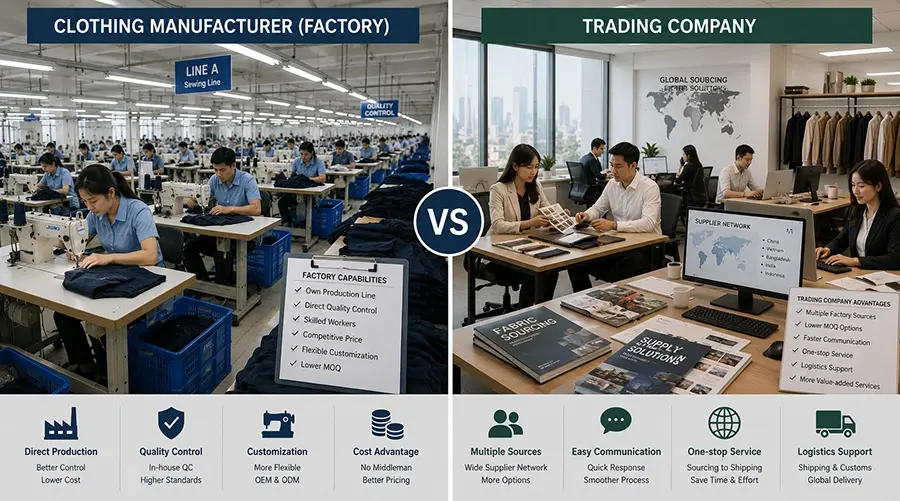
Manufacturer vs Trading Company Comparison Framework
| Factor | Manufacturer | Trading Company | Better Choice |
|---|---|---|---|
| Production Cost | Lower | Higher | Manufacturer |
| Communication | Direct | Indirect | Manufacturer |
| MOQ Flexibility | Usually Higher | Often Lower | Trading Company |
| Product Development | Stronger | Depends on Factory | Manufacturer |
| Multiple Product Categories | Limited | More Flexible | Trading Company |
| Factory Access | Direct | Limited | Manufacturer |
| Supply Chain Management | Self-Managed | Supported | Trading Company |
Both models have advantages depending on your business needs.
When a Clothing Manufacturer Is the Better Choice
Working directly with a manufacturer is usually the better option when:
- You want lower production costs
- You need custom product development
- You want direct communication with production teams
- You plan long-term production
- You want greater quality control
Many growing brands eventually move toward OEM clothing manufacturing services as production volumes increase.
When a Trading Company Is the Better Choice
A trading company may be a better option when:
- You are new to clothing sourcing
- You need multiple product categories
- You have limited supplier management experience
- You want a single point of contact
- Your order quantities are still relatively small
For some startups, the convenience of a trading company outweighs the additional cost.
Best Choice for Different Types of Brands
Startup Clothing Brands
Many startups have limited sourcing experience and may benefit from additional guidance.
A trading company or a flexible manufacturer can both be suitable depending on the complexity of the products being developed.
Growing Clothing Brands
Growing brands often benefit from working directly with manufacturers.
Direct communication and lower production costs become more important as order volumes increase.
Established Clothing Brands
Established brands usually prefer direct manufacturer relationships.
This provides greater control over product development, production planning, quality control, and pricing.

Final Recommendation
| Your Situation | Recommended Option |
|---|---|
| First-Time Buyer | Trading Company or Flexible Manufacturer |
| Small Clothing Brand | Flexible Manufacturer |
| Growing Clothing Brand | Manufacturer |
| Established Brand | Manufacturer |
| Complex Multi-Category Program | Trading Company |
| Long-Term Private Label Program | Manufacturer |
The right choice depends on your business goals rather than a universal rule.
Many successful brands start with sourcing support and later transition to direct factory relationships as they gain experience.
Ready to Choose the Right Production Partner?
Whether you work with a manufacturer or a trading company, the goal is to find a reliable supplier that can support your brand’s growth.
If you’re evaluating suppliers and considering direct production, learn more about our custom clothing manufacturing services and how we support brands with product development, sampling, and bulk production.
FAQs
Are clothing manufacturers cheaper than trading companies?
In many cases, yes. Manufacturers usually offer lower pricing because there is no intermediary involved.
Do trading companies own factories?
Some do, but many work with independent manufacturing partners. Always verify production capabilities before placing an order.
Which option is better for startup clothing brands?
It depends on the brand’s experience, product complexity, and sourcing requirements. Both options can work in the right situation.
Can I visit a clothing manufacturer before placing an order?
Yes. Many manufacturers offer factory visits or virtual tours as part of the supplier evaluation process.
How can I tell if a supplier is a manufacturer or a trading company?
Ask about factory ownership, production facilities, production capacity, and whether manufacturing is performed in-house or outsourced.
Share With
Related Articles


Hot Products