Why Clothing Manufacturers Have Different MOQ Requirements
Many apparel brands are surprised when they contact several manufacturers and receive completely different MOQ requirements.
One factory may accept 50 pieces.
Another may require 100 pieces.
A third may insist on 300 pieces or more.
This often leads buyers to ask:
Why are the MOQ requirements so different?
The answer is that MOQ is influenced by far more than a factory’s preference. Understanding these factors can help buyers compare suppliers more effectively and choose the right clothing production partner for their business.
Quick Answer: Why Do Manufacturers Have Different MOQs?
MOQ requirements usually vary because of:
- Fabric sourcing requirements
- Product complexity
- Factory size and production capacity
- Production efficiency
- Customer focus
- Business model
A lower MOQ does not automatically mean a better factory.
Likewise, a higher MOQ does not automatically mean a factory is difficult to work with.
The key is understanding why the MOQ exists.
Factory Perspective: How Manufacturers Set MOQ
Most factories do not choose MOQ requirements randomly.
When setting an MOQ, manufacturers typically evaluate:
- Material purchasing requirements
- Production setup costs
- Labor efficiency
- Machine utilization
- Production scheduling
- Profitability
Factories must balance flexibility with production efficiency.
If quantities are too low, setup costs become difficult to recover, and production efficiency drops significantly.
This is why different manufacturers often establish different MOQ policies.
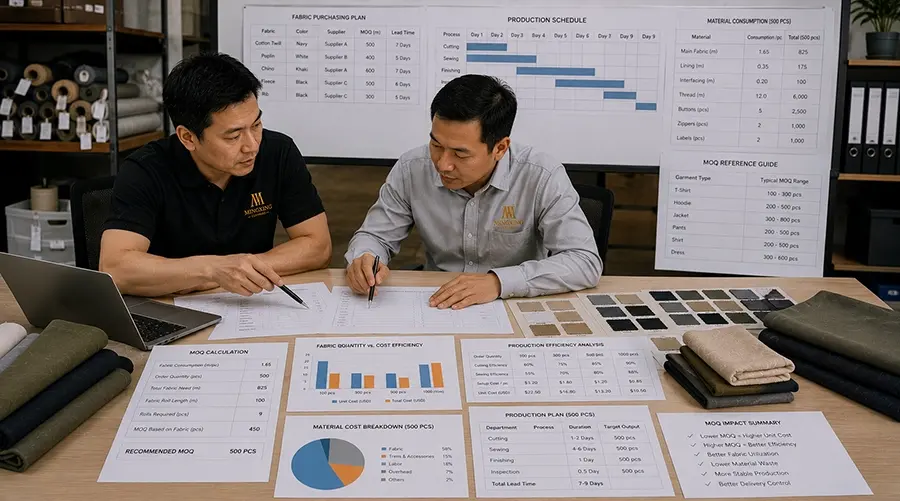
The 5 Factors That Usually Affect MOQ Requirements
Fabric Requirements
Fabric is often the biggest reason MOQ requirements vary.
For example:
- Stock fabrics support lower MOQs
- Custom colours usually increase MOQs
- Custom fabrics often require much larger quantities
In many cases, the fabric supplier influences MOQ more than the garment factory itself.
Product Complexity
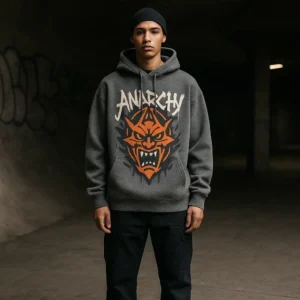
A basic T-shirt requires less setup than a fully customised hoodie with:
- Embroidery
- Custom labels
- Specialty fabrics
- Multiple trims
As complexity increases, MOQ requirements often increase as well.
Factory Production Capacity
Different factories operate at different scales.
Smaller factories may be comfortable with lower-volume projects.
Larger factories often need larger orders to maintain production efficiency.
Factory Business Model
Some manufacturers focus on:
- Startup brands
- Small-batch production
- Product development
Others focus on:
- Established brands
- Wholesale programs
- Large-volume production
Their MOQ requirements naturally reflect the customers they serve.
Production Efficiency
Every order requires:
- Planning
- Material preparation
- Production setup
- Quality control
- Packaging
Many of these costs are similar whether a factory produces 50 pieces or 500 pieces.
Higher MOQs help spread those costs across more units.
The Hidden Trade-Off Behind Low MOQs
Many buyers assume lower MOQs are always better.
| Lower MOQ Benefits | Lower MOQ Trade-Offs |
|---|---|
| Lower inventory risk | Higher unit cost |
| Easier product testing | Fewer fabric options |
| Lower upfront investment | Less production efficiency |
| More flexibility | Limited customization options |
Why Low MOQ Suppliers Often Charge Higher Prices
This is one of the most misunderstood parts of garment manufacturing.
Many buyers compare:
| Factory | MOQ | Price |
|---|---|---|
| Factory A | 50 pcs | $12 |
| Factory B | 300 pcs | $8 |
and wonder:
Why is the lower MOQ supplier more expensive?
The answer is simple.
Smaller production runs often result in:
- Higher setup costs per piece
- Lower production efficiency
- More manual handling
- Less purchasing leverage on materials
Factories offering low MOQs are providing flexibility, and that flexibility usually carries a cost.
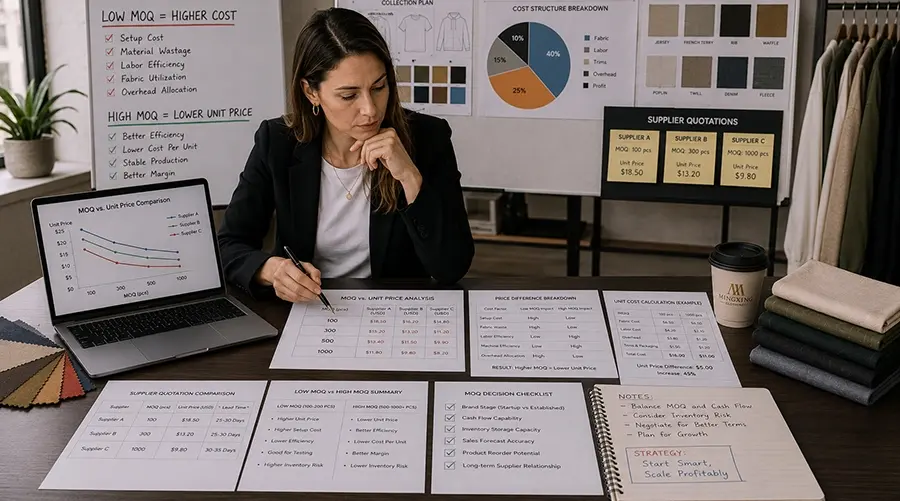
A Simple MOQ Comparison Example
Imagine three factories quoting the same custom hoodie.
| Factory | MOQ | Unit Price | Typical Customer |
|---|---|---|---|
| Factory A | 50 pcs | $12 | Startup Brand |
| Factory B | 100 pcs | $10 | Growing Brand |
| Factory C | 300 pcs | $8 | Wholesale Buyer |
Which factory is best?
The answer depends entirely on your business stage.
A startup testing a new product may benefit from Factory A.
A wholesale buyer scaling proven products may benefit from Factory C.
The lowest MOQ and the highest MOQ can both be correct depending on the situation.
Which MOQ Structure Fits Your Brand?
| Brand Type | Typical Best Fit |
|---|---|
| Startup Brand | Lower MOQ |
| Testing New Products | Lower MOQ |
| Growing Brand | Medium MOQ |
| Proven Bestseller | Higher MOQ |
| Wholesale Business | Higher MOQ |
The best MOQ should support your business objectives, not simply reduce quantity requirements.
MOQ Comparison Checklist
Before comparing manufacturers, ask:
✓ Are fabric requirements identical?
✓ Is product complexity comparable?
✓ Are production capacities similar?
✓ Is the factory targeting the same customer type?
✓ Does the MOQ fit my current business stage?
✓ How much unit cost can be saved at higher quantities?
These questions often explain why manufacturers provide different MOQ requirements.
When Should You Accept a Higher MOQ?
A higher MOQ may make sense when:
- Demand has already been validated
- Reorders are likely
- Material purchasing requires larger quantities
- Significant unit-cost savings are available
- Long-term profitability improves
Higher MOQ does not automatically mean higher risk if the product already has proven demand.
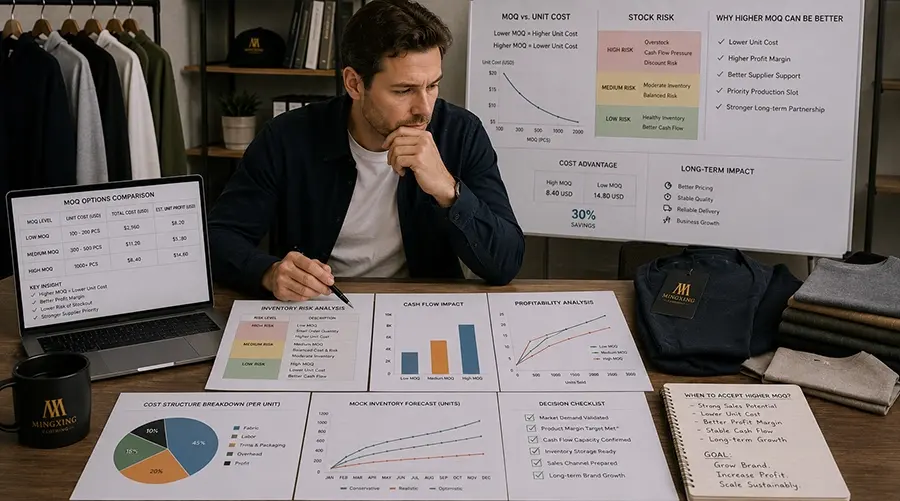
Ready to Evaluate MOQ Requirements More Effectively?
MOQ should always be evaluated within the context of your product, budget, and growth plans.
If you’re comparing manufacturers and trying to determine which MOQ structure makes the most sense for your business, Contact Mingxing Clothing for guidance on production planning and supplier evaluation.
FAQs
Why does one factory require 50 pieces while another requires 300 pieces?
MOQ requirements are influenced by fabric sourcing, production efficiency, factory size, and customer focus.
Is a lower MOQ always better?
No. Lower MOQs reduce inventory risk but often increase unit costs and limit production efficiency.
Can custom fabrics increase MOQ requirements?
Yes. Custom fabrics and custom colours often require larger material purchases, which can significantly increase MOQs.
Why do some factories refuse small orders even when I accept higher prices?
Some factories prioritise production scheduling, efficiency, and customer type. Even with a higher price, a very small order may not fit their business model.
Should MOQ be the main factor when choosing a manufacturer?
No. Product capability, quality control, communication, and production experience are usually more important than MOQ alone.
Share With
Related Articles

Hot Products