MOQ is the minimum order quantity required by a factory before production begins.
It directly determines whether a clothing product can move into manufacturing, and it has a direct impact on cost, supplier selection, and production planning.
For most brands, understanding MOQ is essential before working with any clothing manufacturer.
How MOQ Affects Cost in Clothing Production
MOQ directly impacts unit cost.
- Low MOQ increases unit cost
- High MOQ reduces unit cost
This is because fixed production costs are distributed across total units.
Fixed costs include:
- Fabric preparation
- Cutting and sampling
- Machine setup
- Labor allocation
These costs remain almost the same whether you produce 50 or 500 pieces.
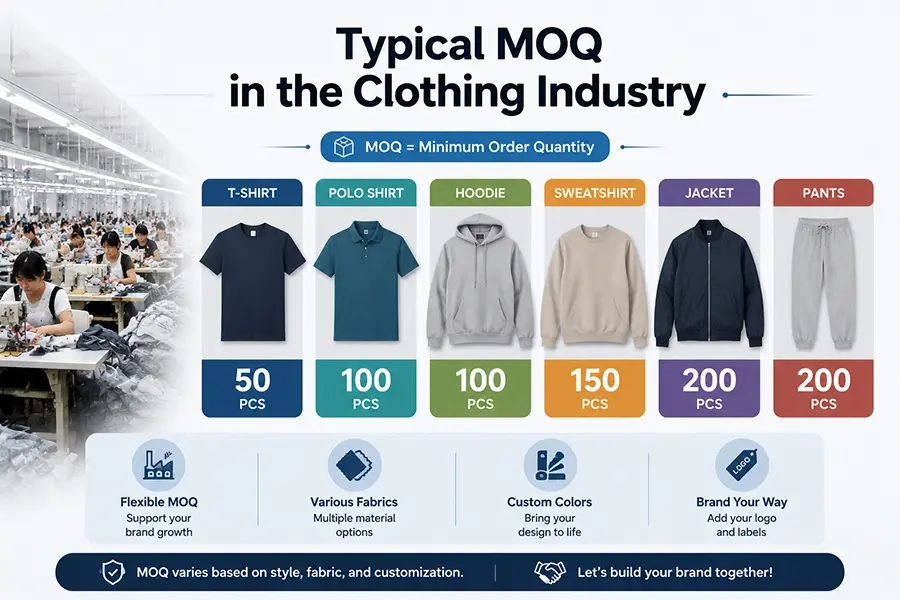
Typical MOQ in the Clothing Industry
Common MOQ ranges:
- T-shirt: 50–100 pcs
- Hoodie: 100–200 pcs
- Jacket: 200–300 pcs
- Complex garments: 300–500 pcs
More complex designs require higher MOQ due to longer production time and higher material waste.
Why Factories Set MOQ Requirements
MOQ is not an arbitrary rule.
It is based on production economics.
Key reasons:
- Fabric procurement efficiency
- Production line setup cost
- Labor scheduling efficiency
- Waste reduction
MOQ ensures factories operate at stable production efficiency levels.
How MOQ Affects Brand Strategy
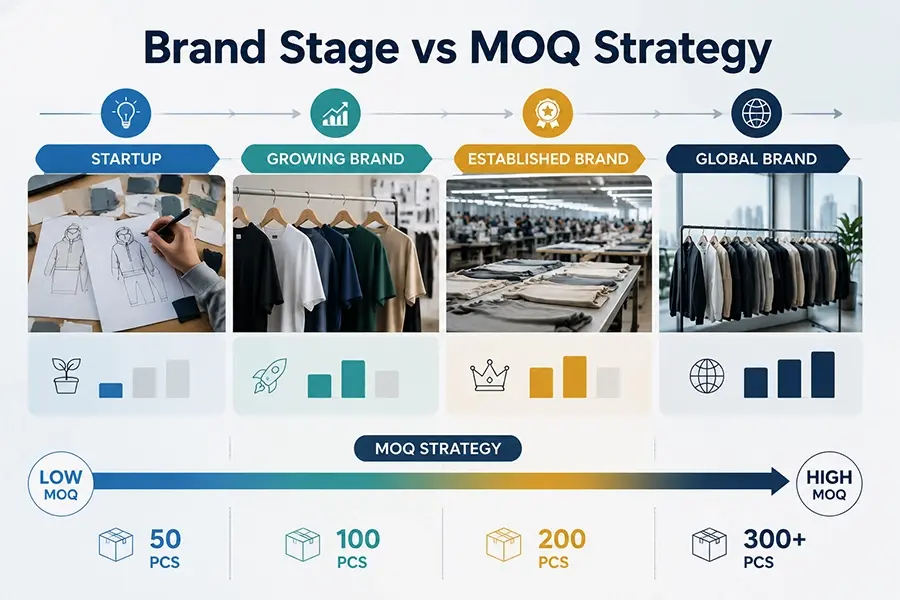
MOQ should always align with your business stage.
Startup brands usually choose a lower MOQ because they need flexibility to test the market.
Growing brands balance cost and scalability as production stabilises.
Established brands rely on higher MOQ to improve cost efficiency and margins.
Brands that scale successfully often adjust MOQ gradually as demand becomes more predictable.
How to Reduce MOQ in Clothing Production
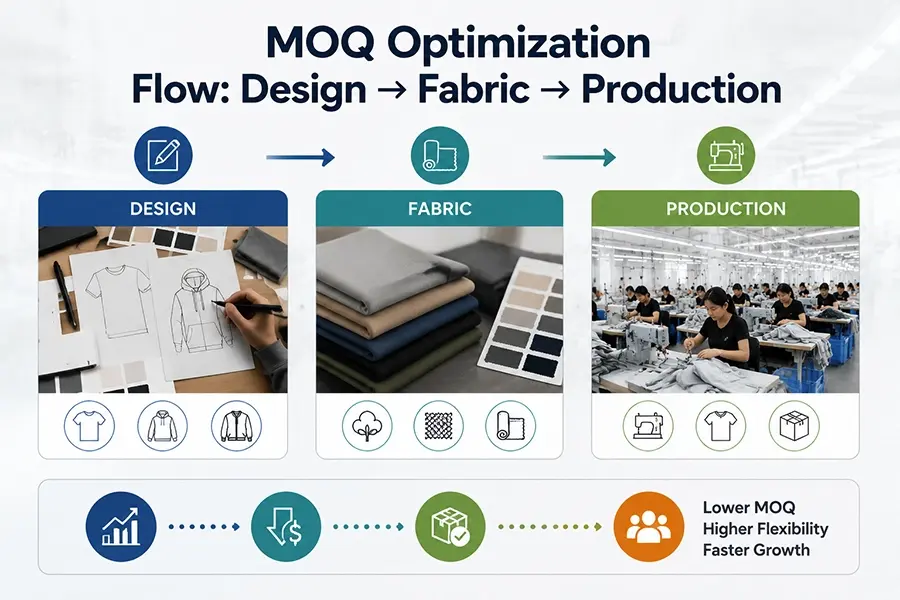
MOQ can be optimised through production planning:
- Using stock fabrics instead of custom fabrics
- Simplifying garment design structure
- Reducing color variations
- Combining multiple styles under the same fabric base
- Working with flexible manufacturers who support small batch production
These strategies help brands reduce entry risk while maintaining production quality.
Real Production Example: MOQ Impact on Cost
Example:
A 100-piece order usually results in a higher unit cost because setup costs are distributed across fewer units.
A 500-piece order reduces unit cost significantly due to better cost allocation.
This difference directly affects pricing strategy and profit margins.
MOQ decisions, therefore, influence both production and financial outcomes.
MOQ Decision Guide for Clothing Brands
MOQ selection depends on your production stage:
- Testing stage → low MOQ for flexibility
- Growth stage → balanced MOQ for scalability
- Stable stage → high MOQ for cost efficiency
MOQ is both a production requirement and a strategic business decision.
Contact for MOQ Optimisation
If you are planning clothing production and want to understand how MOQ affects cost, production planning, or supplier selection, contact Mingxing Clothing to evaluate the best manufacturing approach for your brand.
FAQs