
Should You Choose the Cheapest Clothing Manufacturer?
Imagine receiving three quotations for the same product.
Factory A: $8
Factory B: $10
Factory C: $13
Which one should you choose?
For many buyers, the answer seems obvious.
Choose the cheapest option.
However, experienced apparel brands know that the lowest price is not always the lowest-cost decision. In some cases, a factory that saves you money today may cost you significantly more later.
Understanding when a low-cost supplier makes sense—and when it doesn’t—can help you make better sourcing decisions and work with the right OEM clothing manufacturer for your business.
Quick Answer: Should You Choose the Cheapest Manufacturer?
Usually, no.
But not always.
The cheapest manufacturer can be the right choice when:
- Product requirements are simple
- Quality expectations are moderate
- Production risks are low
- The project is focused on cost control
However, for premium products, complex garments, and long-term brand development, choosing solely based on price often creates bigger problems later.
The goal is not to find the cheapest manufacturer.
The goal is to find the best value.
Why Cheap Prices Feel So Attractive
There is a reason buyers naturally focus on price.
Lower pricing can mean:
- Lower startup costs
- Less inventory risk
- Better cash flow
- Higher profit margins
- Easier product testing
For startup brands especially, controlling investment risk is often a top priority.
The problem begins when price becomes the only factor in the decision-making process.
Why Buyers Choose the Cheapest Supplier
Most buyers choose the lowest-priced supplier for one of four reasons:
Limited Budget
New brands often have restricted budgets and need to control spending carefully.
Product Testing
Before investing heavily, brands may want to test market demand.
Inventory Risk
Lower investment reduces the risk of unsold stock.
Margin Pressure
Some businesses compete primarily on price and need lower production costs to remain competitive.
These are all valid reasons.
The question is whether the cheapest supplier can also meet your quality and production expectations.
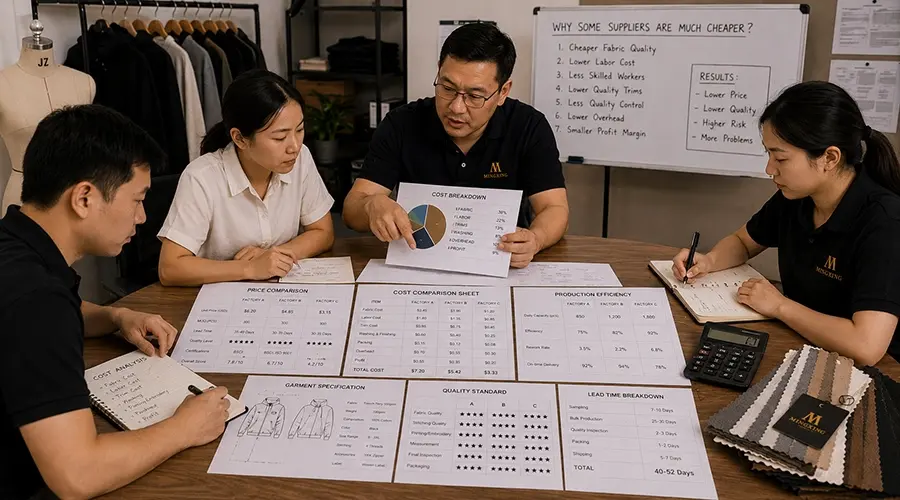
Factory Perspective: Why Some Suppliers Are Much Cheaper
When one factory is significantly cheaper than the others, there is usually a reason.
Common explanations include:
- Lower material costs
- Simpler construction methods
- Reduced quality control procedures
- Lower labor costs
- Different production standards
- Higher MOQ requirements
- Less customer support
Sometimes these differences are acceptable.
Sometimes they create serious risks.
The important thing is understanding what has been removed from the quotation to achieve the lower price.
Not Every Cheap Factory Is Bad
One common misconception is that every low-priced factory is unreliable.
This is not true.
Some manufacturers can offer lower pricing because they have:
- Efficient production systems
- Long-term fabric supplier relationships
- Lower operating costs
- Specialised expertise in specific products
- High production volumes
A low price is not automatically a warning sign.
The real question is:
Why is this factory cheaper?
The answer matters more than the number itself.
The Hidden Cost of Choosing the Cheapest Supplier
The biggest sourcing mistake is focusing only on the quoted price.
A factory may save you:
- $1 per piece
- $2 per piece
- A few hundred dollars on the order
But later create:
- Quality issues
- Production delays
- Rework costs
- Customer complaints
- Refund requests
A lower purchase price does not always mean a lower total business cost.
A Real Cost Comparison Example
Imagine a 1,000-piece hoodie order.
| Factory | Unit Price | Order Value |
|---|---|---|
| Factory A | $8 | $8,000 |
| Factory B | $10 | $10,000 |
At first glance, Factory A saves:
$2,000
However, suppose Factory A delivers an 8% defect rate that requires:
- Product replacement
- Rework
- Additional shipping
- Customer service time
Total recovery cost:
$3,500+
In this situation, the cheaper supplier actually becomes the more expensive choice.
This is why experienced buyers evaluate total risk, not just unit cost.
When the Cheapest Manufacturer Can Be the Right Choice
There are situations where the lowest-priced supplier may be the correct decision.
Promotional Products
Products designed for short-term marketing campaigns often prioritise cost over premium quality.
Event T-shirts
Many event products have limited use and lower quality requirements.
Market Testing
Brands testing a new concept may choose lower-cost suppliers to reduce risk.
Standard Products
Simple products using stock fabrics and basic construction generally involve fewer production challenges.
For these projects, price can legitimately be one of the most important decision factors.
When You Should Avoid the Cheapest Manufacturer
There are also situations where choosing solely on price creates unnecessary risk.
Premium Brands
Customers paying premium prices expect premium quality.
Complex Garments
Products involving:
- Embroidery
- Garment washing
- Specialty fabrics
- Technical construction
require stronger manufacturing capabilities.
Tight Deadlines
Production delays can easily cost more than the original savings.
New Product Development
Many brands underestimate the value of strong garment development services during product creation.
Development support, communication, and technical problem-solving often matter more than a small difference in unit price.

The Best Manufacturer for One Brand May Be the Wrong Manufacturer for Another
There is no universal “best” manufacturer.
Different businesses require different solutions.
| Brand Type | Typical Priority |
|---|---|
| Startup Brand | Low MOQ and flexibility |
| Growing Brand | Balance between cost and quality |
| Premium Brand | Quality and consistency |
| Wholesale Business | Large capacity and lower unit cost |
The best supplier is the one that fits your business model—not necessarily the one with the lowest price.
Lowest Price vs Best Value
Many buyers confuse these two concepts.
| Lowest Price | Best Value |
|---|---|
| Focuses on cost only | Considers cost, quality, and risk |
| Short-term thinking | Long-term thinking |
| May create future problems | Reduces future problems |
| Cheapest today | Most profitable over time |
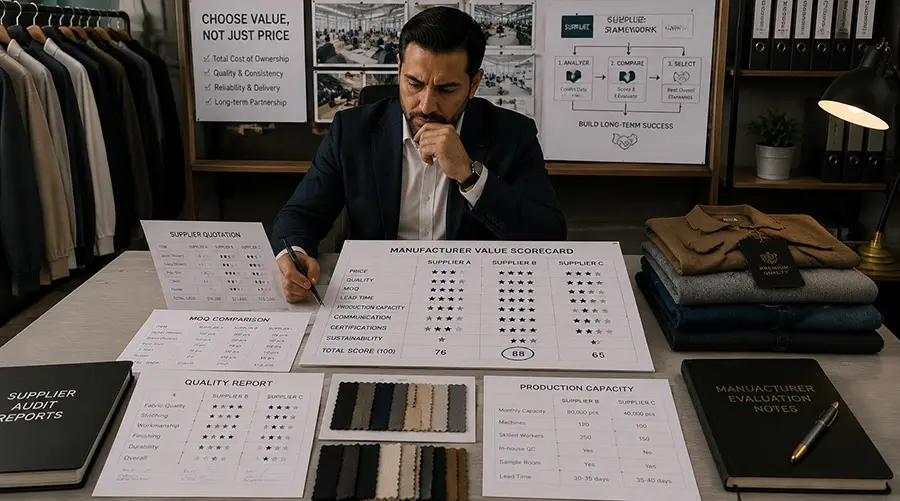
Manufacturer Value Scorecard
Before choosing a factory, score each supplier using the following framework.
| Evaluation Area | Weight |
|---|---|
| Product Capability | 25% |
| Fabric Quality | 20% |
| Communication | 15% |
| MOQ Fit | 15% |
| Price | 15% |
| Lead Time | 10% |
This approach helps buyers evaluate overall value rather than focusing entirely on cost.
Supplier Decision Checklist
Before selecting a manufacturer, ask:
✓ Can they produce my product correctly?
✓ Does the quality match my brand positioning?
✓ Is the MOQ suitable for my business?
✓ Are communication standards acceptable?
✓ Is the lead time realistic?
✓ Do the price savings justify the potential risks?
✓ Would I feel comfortable placing a repeat order?
If several answers are unclear, more supplier evaluation is needed before making a decision.
Ready to Evaluate Manufacturers More Effectively?
Choosing a manufacturer is one of the most important decisions an apparel brand makes.
The lowest quote is not always the wrong choice.
But it should never be the only reason for choosing a supplier.
If you’re comparing factories and need help evaluating pricing, quality standards, MOQ requirements, and production capabilities, Contact Mingxing Clothing.
FAQs
Is the cheapest clothing manufacturer always a bad choice?
No. For simple products, market testing, and low-risk projects, a lower-priced supplier can sometimes be the right choice.
Why are some manufacturers significantly cheaper than others?
Differences in materials, quality standards, production processes, overhead costs, and service levels often explain pricing differences.
How much cheaper is too cheap?
If one quotation is 5–10% lower than competitors, this may be normal. If a quote is 30–40% lower than those from other suppliers, buyers should investigate carefully.
Can a higher-priced manufacturer save money in the long run?
Yes. Better quality control, stronger communication, and lower defect rates often reduce total sourcing costs.
What should I compare besides price?
Product capability, fabric quality, quality control, communication, MOQ requirements, and lead times should all be evaluated before making a decision.
Share With
Related Articles
Hot Products