What Is the Right MOQ for Your Clothing Brand?
Many clothing brands assume that the lowest MOQ is always the best option.
In reality, choosing the wrong MOQ can increase inventory risk, reduce profitability, and create unnecessary production challenges. Working with the right apparel manufacturing partner means finding a production quantity that aligns with your budget, sales expectations, and business goals.
The goal is not to find the lowest MOQ.
The goal is to find the right MOQ.
Quick MOQ Recommendation
While every project is different, the following guidelines work for many apparel brands.
| Brand Type | Recommended MOQ | Reason |
|---|---|---|
| Startup Brand | 50–100 pcs per style/color | Lower inventory risk and easier market testing |
| Growing Brand | 100–300 pcs per style/color | Better balance between cost and flexibility |
| Established Brand | 300+ pcs per style/color | Lower unit costs and stronger production efficiency |
The right MOQ always depends on your product, customisation requirements, and business strategy.
Why MOQ Requirements Vary Between Manufacturers
Many buyers are surprised when different factories provide different MOQ requirements for similar products.
This usually happens because MOQ is influenced by multiple production factors.
Common reasons include:
- Fabric supplier minimums
- Product complexity
- Printing and embroidery requirements
- Production efficiency
- Custom trims and accessories
- Factory production capacity
A factory is not simply choosing a random MOQ. In many cases, the quantity is determined by the economics of production.
The 5 Factors That Matter Most When Choosing an MOQ
Before deciding on an MOQ, evaluate the factors that have the greatest impact on your business.
| Factor | Importance |
|---|---|
| Sales Confidence | ⭐⭐⭐⭐⭐ |
| Product Complexity | ⭐⭐⭐⭐ |
| Fabric Requirements | ⭐⭐⭐⭐ |
| Budget Availability | ⭐⭐⭐⭐ |
| Customization Level | ⭐⭐⭐ |
Understanding these factors often leads to better sourcing decisions than focusing on MOQ alone.
Sales Confidence: Can You Sell the Product?
This is usually the most important consideration.
A larger MOQ may reduce unit costs, but unsold inventory quickly eliminates those savings.
Ask yourself:
- Is this a proven product?
- Do I already have customers?
- Have I validated demand?
- Am I confident in future sales?
Brands launching new products often benefit from lower MOQs during the testing stage.
Product Complexity
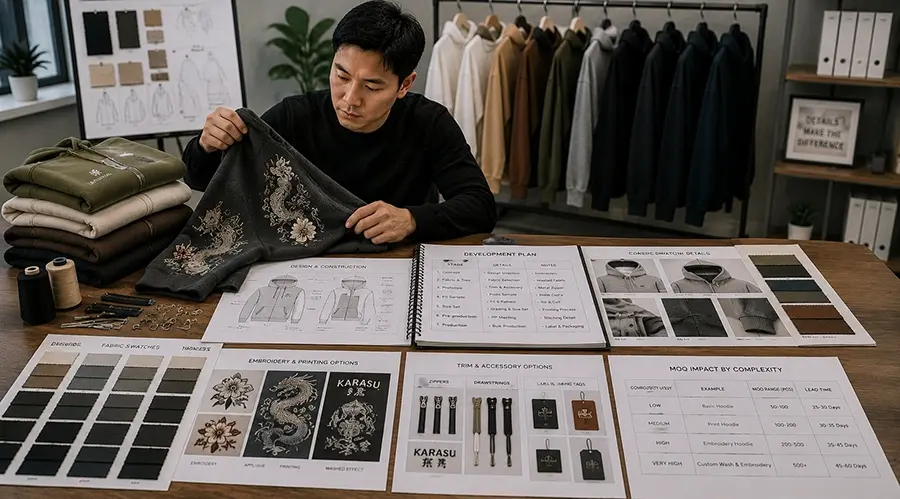
The more complex the product, the higher the MOQ may become.
Examples include:
- Technical sportswear
- Custom-dyed garments
- Multi-panel construction
- Special washing processes
- Performance fabrics
Simple products generally allow for greater production flexibility.
Fabric Requirements
Many MOQ challenges actually come from fabric suppliers rather than garment factories.
For example:
- Custom fabrics often require larger minimums
- Custom colours increase material requirements
- Speciality fabrics may only be available in bulk quantities
Understanding fabric minimums can prevent unrealistic MOQ expectations.
Budget Availability
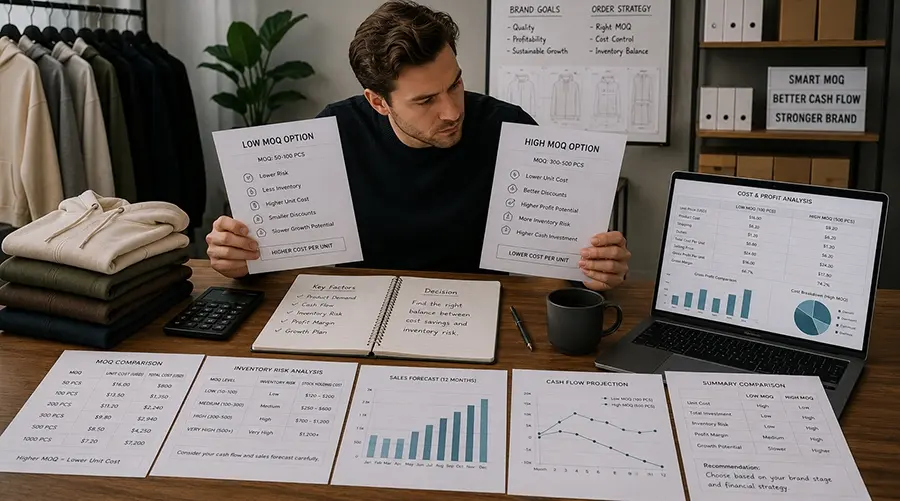
Lower MOQs reduce inventory risk but often increase the unit cost.
Higher MOQs typically improve production efficiency but require greater upfront investment.
The best MOQ balances:
- Inventory risk
- Unit cost
- Available cash flow
- Growth objectives
Customization Level
Every additional customisation requirement can increase production complexity.
Examples include:
- Custom labels
- Custom packaging
- Embroidery
- Specialty printing
- Custom trims
The more customisation involved, the more likely MOQ requirements will increase.
Many brands discover that the best garment production solutions are not necessarily the ones offering the lowest MOQ.
Should You Choose a Higher or Lower MOQ?
Use this framework when evaluating your options.
| Situation | Lower MOQ | Higher MOQ |
|---|---|---|
| Testing a New Product | ✅ | ❌ |
| Launching a New Brand | ✅ | ❌ |
| Limited Budget | ✅ | ❌ |
| Proven Bestseller | ❌ | ✅ |
| Scaling Production | ❌ | ✅ |
| Reducing Unit Cost | ❌ | ✅ |
There is no universal answer.
The right MOQ depends on your specific business situation.
Common MOQ Mistakes Clothing Brands Make
Many apparel brands make the same mistakes when discussing MOQ with manufacturers.
Focusing Only on the Lowest MOQ
A lower MOQ often results in a higher unit cost.
The lowest MOQ is not always the most profitable option.
Ordering More Than You Can Sell
Large production runs reduce costs but increase inventory risk.
Unsold inventory is usually more expensive than a slightly higher unit cost.
Ignoring Fabric Minimums
Fabric requirements often determine the practical MOQ.
This is especially true for custom fabrics and colours.
Comparing Suppliers by MOQ Alone
MOQ should be evaluated alongside:
- Product capability
- Communication
- Quality control
- Production experience
Trying to Customise Everything at Low Quantities
Many startups want:
- Custom fabric
- Custom color
- Custom labels
- Custom packaging
while ordering only 50 pieces.
In reality, some customisation options become more practical at higher production quantities.
MOQ Evaluation Checklist
Before agreeing to a manufacturer’s MOQ, ask yourself:
✓ Can I realistically sell this quantity?
✓ Does the MOQ fit my current budget?
✓ Does a higher MOQ significantly reduce unit cost?
✓ Is inventory risk manageable?
✓ Have I validated market demand?
✓ Do customisation requirements justify the quantity?
If several answers are “no,” a lower MOQ may be the better option.
When Should You Accept a Higher MOQ?
Accepting a higher MOQ often makes sense when:
- The product has proven demand
- Reorders are likely
- Cost savings are significant
- Fabric purchasing requires larger quantities
- Production efficiency improves substantially
In many cases, a higher MOQ can create better long-term profitability.
Ready to Discuss MOQ Options for Your Project?
Every clothing brand has different production goals.
The right MOQ depends on your product, customisation requirements, budget, and growth plans.
Contact Mingxing Clothing to discuss your project and determine the most suitable production quantity for your brand.
FAQs
Is a lower MOQ always better?
No. Lower MOQs reduce inventory risk but often increase unit costs.
Why do custom garments usually require higher MOQs?
Custom fabrics, trims, labels, and production setups often require larger production quantities to remain cost-effective.
Can I negotiate a manufacturer's MOQ?
Sometimes. MOQ flexibility depends on product type, materials, customisation requirements, and future business potential.
Can different colours affect MOQ requirements?
Yes. Multiple colours often increase fabric consumption requirements and may affect production efficiency, which can influence MOQ.
Should MOQ be more important than unit price?
Neither should be evaluated independently. The best decision balances MOQ, unit cost, inventory risk, and long-term business goals.
Share With
Related Articles

Hot Products