Red Flags When Choosing a Clothing Manufacturer
Choosing the wrong clothing manufacturer can lead to production delays, quality issues, missed deadlines, and unexpected costs.
Many suppliers look professional at first glance. They may have attractive websites, competitive pricing, and fast responses. However, not every supplier is a good fit for your brand.
Understanding these warning signs can help you choose a more reliable custom clothing manufacturer and avoid costly sourcing mistakes.
Quick Red Flag Checklist
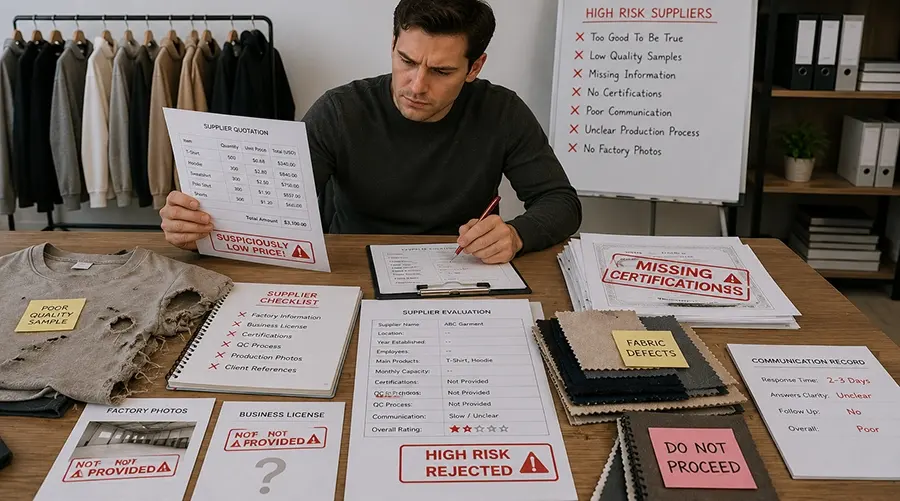
Before investing time in samples or production discussions, watch for these warning signs:
- Refuses to share factory information
- Pricing is dramatically lower than competitors
- Sample quality is poor
- Delivery timelines are unclear
- Answers change frequently
- Product experience is limited
- Communication is consistently slow
If several of these issues appear together, additional verification is strongly recommended.
Critical Red Flags: Walk Away Immediately
These warning signs often indicate serious supplier risks.
Refuses to Share Basic Factory Information
A legitimate manufacturer should be willing to explain:
- Factory location
- Product specialization
- Production capabilities
- Team structure
If a supplier consistently avoids these questions, transparency may be a concern.
Pricing Is Far Below Everyone Else
Extremely low pricing often creates problems later.
Common causes include:
- Lower-quality materials
- Outsourced production
- Missing costs
- Unrealistic quotations
A factory should not be selected based on price alone.
Sample Quality Is Poor
The sample is usually the best preview of future production quality.
If basic workmanship, measurements, or finishing cannot meet expectations during sampling, bulk production rarely improves.
No Verifiable Business Presence
Professional manufacturers should have a business presence.
Examples include:
- Company website
- Factory photos
- Business registration information
- Trade show participation
- Customer references
Complete lack of verifiable information should be treated as a major risk.
Warning Signs: Investigate Further
These issues do not automatically eliminate a supplier but require additional verification.
Slow Communication
Delays happen.
However, repeated slow responses during quotations and sampling may indicate future project management problems.
Unclear MOQ Requirements
Reliable manufacturers should clearly explain their MOQ structure.
Constantly changing MOQ requirements can create confusion and planning difficulties.
Vague Production Timelines
Factories should provide realistic lead times.
If delivery schedules remain unclear throughout discussions, further investigation is recommended.
Limited Product Experience
A factory may be reliable but still lack experience producing your type of product.
Reviewing their custom apparel manufacturing capabilities can help determine whether they are a suitable match.
Constantly Changing Answers
Consistency matters.
If pricing, MOQ, timelines, or production information changes repeatedly, communication and project management may become difficult later.
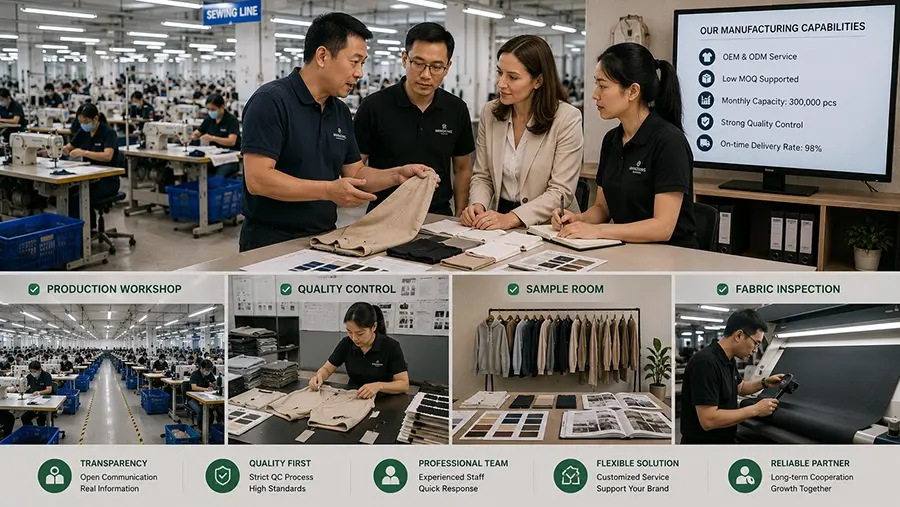
What Reliable Manufacturers Usually Do
Reliable manufacturers often show positive signs long before production begins.
Instead of focusing only on red flags, buyers should also pay attention to behaviours that indicate a supplier is professional and trustworthy.
Some common green flags include:
- Answers questions clearly and consistently
- Provides realistic pricing and lead times
- Offers constructive feedback during sampling
- Explains quality control procedures openly
- Shares factory information and production capabilities when requested
- Identifies potential production challenges early instead of making unrealistic promises
When several of these positive signs appear together, it is often a good indication that the supplier has experience working with international clothing brands.
Should You Continue Evaluating This Manufacturer?
Use this simple decision framework.
Continue Evaluation
- No critical red flags
- One minor warning sign
Proceed Carefully
- Two to three warning signs
- Additional verification required
Walk Away
- Any critical red flag
- Multiple warning signs combined
- Serious concerns regarding transparency
The goal is not to find a perfect supplier. The goal is to reduce risk before production begins.
Clothing Manufacturer Risk Evaluation Framework
| Risk Factor | Risk Level | What It Usually Indicates |
|---|---|---|
| Refuses Factory Information | High | Lack of transparency |
| Extremely Low Pricing | High | Potential quality issues |
| Poor Sample Quality | High | Future production risks |
| No Business Presence | High | Verification concerns |
| Slow Communication | Medium | Project management concerns |
| Unclear MOQ | Medium | Planning uncertainty |
| Limited Product Experience | Medium | Development challenges |
| Transparent Communication | Positive | Strong supplier reliability |
| Clear QC Process | Positive | Better production consistency |
Ready to Evaluate Clothing Manufacturers More Effectively?
The best sourcing decisions come from careful evaluation rather than low pricing alone.
If you’re looking for a supplier with transparent communication, established quality control processes, and proven manufacturing experience, learn more about Mingxing Clothing factory capabilities and how we support growing apparel brands.
FAQs
Is low pricing always a red flag?
No. However, pricing significantly lower than that of competing suppliers should always be investigated carefully.
Should I avoid a manufacturer with no website?
Not necessarily, but additional verification is recommended before moving forward.
How important is sample quality when evaluating a factory?
Very important. Samples often provide the clearest indication of future production quality.
Can communication problems become production problems?
Yes. Poor communication during the quotation stage often becomes a larger issue during sampling and bulk production.
What is the biggest red flag when choosing a clothing manufacturer?
Refusing to provide basic factory information and producing poor-quality samples are among the most serious warning signs.
Share With
Related Articles

Hot Products