Quick answer
Garment quality control is the process of comparing materials, workmanship, measurements, decoration, labeling and packing against an approved standard. In production, waiting until finished garments reach the packing table is too late: a fabric or process problem may already affect a large part of the order. Effective control starts before cutting, continues while production is running and ends with a documented release decision.
For a clothing brand, the approved standard normally includes the sealed sample, current tech pack, bill of materials, measurement chart and tolerances, artwork approvals, color references, label files and packing instructions. These references turn subjective comments such as “the quality does not look right” into checks that a factory, brand and third-party inspector can apply consistently.
This guide gives clothing brands a practical garment quality control checklist: how to set the approved standard, inspect at each production stage, use sampling correctly, record evidence and handle a failed result. It also shows why quality control in the garment industry must change with the product rather than applying one unchanged checklist to T-shirts, hoodies, jackets, tracksuits, pants and dresses.
What Is Garment Quality Control?
Garment quality control, or garment QC, consists of the checks used to determine whether a product meets agreed requirements. Depending on the order, those checks may cover fabric identity and shade, garment measurements, stitch construction, print placement, embroidery appearance, trim function, labels, cleanliness and packing.
Quality assurance and quality control support the same objective, but they are not identical.
Swipe horizontally to view the full table.
| Area | Quality assurance (QA) | Quality control (QC) |
|---|---|---|
| Main purpose | Prevent recurring problems by defining and controlling the production system | Detect and record whether actual materials or products conform |
| Typical activities | Supplier approval, document control, process planning, training and risk assessment | Material inspection, inline checks, measurement, visual inspection and final verification |
| Timing | Before and throughout production | At selected points before, during and after production |
| Evidence | Approved procedures, specifications and process records | Measurements, defect records, photographs and inspection decisions |
QC cannot compensate for an unclear specification. If fabric, measurement method, artwork position or packing requirements are not approved, the factory and buyer may inspect the same garment and reach different conclusions. The first QC action is therefore to define the product before bulk production starts.
Build the Approved Quality Standard Before Bulk Production
The approved standard is the common working reference for the brand, factory and inspector. It should answer four questions: What was approved? Which revision is current? How will it be checked? Who can approve a change?
Approved sample and current tech pack
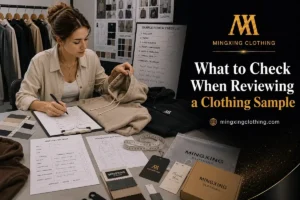
An approved or sealed sample provides a physical reference for appearance, construction, fit, hand feel and workmanship. It should be supported by a current tech pack: a handled sample can change over time or retain a detail that was later revised in writing.
The tech pack should identify the style and revision and include construction details, measurements, artwork positions, labels and any product-specific requirements. When production instructions change, the factory and brand should confirm which revision supersedes the previous one. Mingxing's product development and sample process can be used before bulk production to align product details and sample expectations.
Bill of materials and approved components
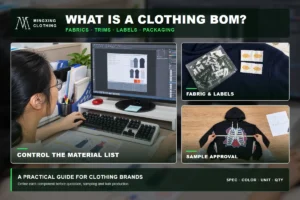
The bill of materials should identify the approved shell fabric, lining, rib, thread, zipper, buttons, elastic, labels and other components. Relevant references may include composition, weight or construction, color, supplier reference and approved alternatives. In production, an unrecorded substitution can change shade, shrinkage, hand feel, strength, fit or care instructions even when it initially looks similar.
Measurements, points of measure and tolerances
A measurement chart is not operational unless it also explains how each point of measure is taken. The garment should be positioned consistently, and the measuring method should identify whether areas are relaxed, stretched, closed or laid flat. Each relevant point needs an agreed tolerance. Tolerances should be selected for the product and construction; one universal tolerance should not be copied across every style or size.
Color, artwork and decoration references
Color should be controlled with an approved physical or otherwise agreed reference, such as a lab dip, strike-off or approved sample. Artwork files should identify the correct version, dimensions, position and color. For printing and embroidery, the approval should also define relevant appearance requirements, such as edge quality, coverage, stitch appearance or surface distortion. These details must be agreed for the actual technique rather than assumed from a digital mock-up.
Labels and packaging
Main labels, size labels, care labels, hangtags, barcodes, polybags, carton assortment and shipping marks should be approved before packing begins. Packaging is part of order accuracy: a correctly made garment can still be commercially unusable if it carries the wrong size label or is packed into the wrong carton assortment. Mingxing's apparel packaging options provide context for planning the packing stage.
When two references conflict, production should not guess. The conflict should be recorded and resolved in writing by an authorized decision-maker before affected work continues.
Who Is Responsible for Quality Decisions?
Quality decisions become faster when responsibility is assigned before a problem occurs.
Swipe horizontally to view the full table.
| Role | Typical responsibility | Decision or evidence |
|---|---|---|
| Brand or product developer | Define product, approve samples and documents, clarify commercial and market requirements | Approved revisions and written change decisions |
| Factory merchandiser or project coordinator | Distribute current requirements and coordinate approvals | Order records and communication trail |
| Production supervisor | Control the operation and correct process problems | Corrective action and production records |
| Factory QC | Inspect at defined stages and record results | Measurements, defects, photographs and status |
| Third-party inspector | Provide an independent inspection when requested | Independent report based on the agreed scope |
| Authorized release owner | Decide whether goods pass, remain on hold or require further action | Written release, rejection or conditional decision |
Job titles vary. What matters is knowing who can stop production, approve a deviation and release goods after reinspection. A verbal “it should be fine” leaves no traceable approval.
Three Garment Inspection Stages

Finding a problem early usually reduces both the affected quantity and the cost of correction. In practice, quality control in garment production is most useful at three stages: incoming materials, first-piece or inline production, and finished goods before shipment.
1. Incoming material inspection before cutting
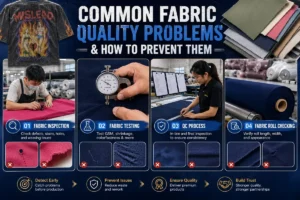
Before cutting, checks may cover material identity, color, shade lot, usable width, weight or construction, surface faults and quantity. Fabric should be compared with the approved reference under suitable viewing conditions. Rolls from different dye lots should be identified so that shade variation is controlled, especially for matching sets or garments with multiple fabric panels.
The inspection plan may also include shrinkage, dimensional stability, colorfastness or other tests when the material and product risk justify them. Trims such as rib, zippers, buttons, elastic, thread and labels should also be checked against their approved references before they are introduced into bulk production.
At Mingxing, purchased fabric is checked for quality and shade variation, compared with the customer-approved sample and inspected using a fabric inspection machine. Finding a material issue here is more useful than discovering it after the fabric has been cut into many garments.
2. First-piece and inline inspection during production
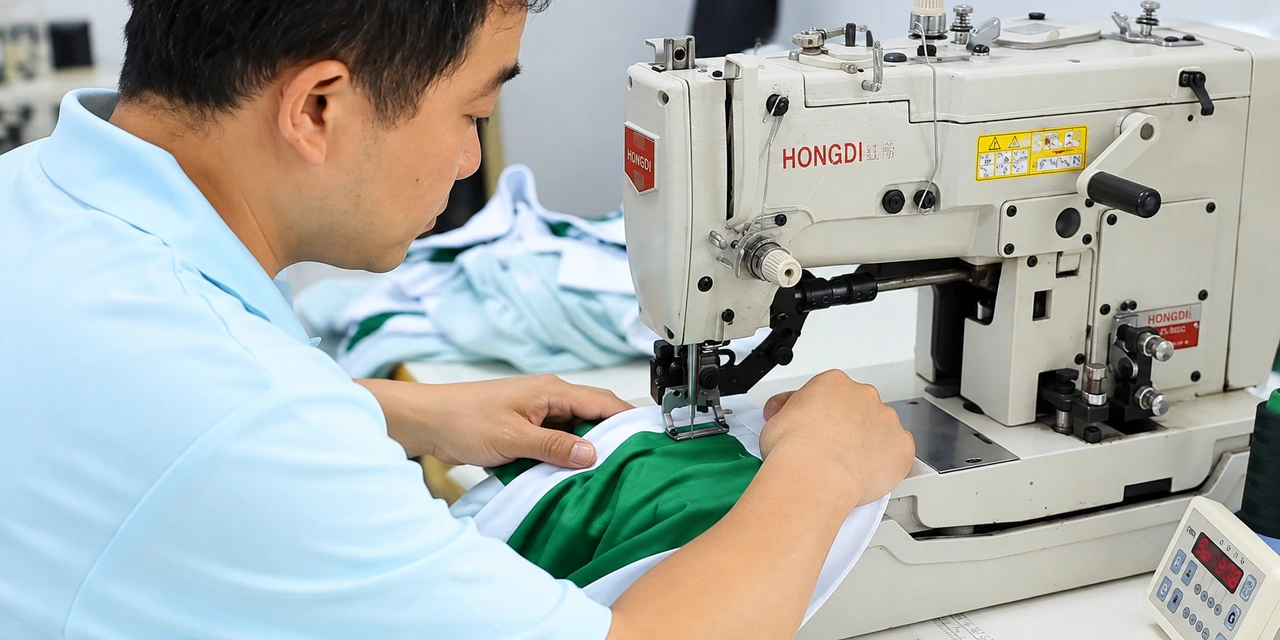
A first-piece check confirms that the production method can reproduce the approved product before the line makes a large quantity. Inline inspection then monitors actual work while cutting, sewing and decoration are underway.
Depending on the style, checks can include grain direction, panel matching, seam type, seam allowance, stitch appearance, critical measurements, symmetry and reinforcement at stress points. Samples should represent different operators, bundles, sizes and colors rather than only pieces selected because they look good.
Printing, embroidery, patches, appliqué, washing and other special processes require their own checkpoints. Inspectors may compare the decoration's position, dimensions, color and surface appearance with the approved artwork and sample. Mingxing checks the size, quality and color of printing, embroidery and other confirmed processes during production.
The main value of an inline check is not simply removing defective pieces. It is stopping the same cause from continuing through the rest of the batch.
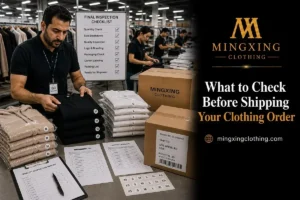
3. Finished-garment and packing inspection
Finished garments should be checked against the approved sample and current specifications. The scope may cover measurements, sewing workmanship, overall appearance, symmetry, decoration, trim function, cleanliness and finishing. Quantity, colors and size assortment should also be reconciled with the order.
At Mingxing, every finished garment is visually checked for appearance and sewing workmanship. Measurements and performance tests are carried out on selected samples according to the order's inspection requirements. Hangtags, main labels, care labels, size labels, outer polybags and master cartons are also checked against the confirmed order details. Inspection tables and photographs are retained as records. The site's clothing production process and apparel manufacturing service show how these checks fit into the wider order workflow.
A final inspection can result in pass, fail or pending status. “Pending” is useful when evidence is incomplete, a test result is outstanding or a deviation requires written approval. The release decision should be based on the agreed inspection scope, not on shipment pressure alone.
Complete Garment Quality Control Checklist

The table below is a framework, not a universal acceptance standard. Each brand should replace general references with the approved requirements for its style.
Swipe horizontally to view the full table.
| Inspection area | Approved reference | What to inspect | Evidence to record |
|---|---|---|---|
| Order identity | PO, style and revision | Style, color, size, quantity and current document version | Order and revision identifiers |
| Fabric | Approved sample, lab dip or material specification | Identity, shade, surface, width, construction and relevant lot differences | Roll or lot, findings and photos |
| Trims | BOM and approved component | Zippers, buttons, rib, elastic, thread and other components | Supplier or lot reference and result |
| Measurements | Measurement chart and method | Required points of measure across relevant sizes | Actual values and tolerance result |
| Cutting | Pattern and construction specification | Grain, nap, panel direction, notches and pattern matching | Sample source and nonconformities |
| Sewing | Approved sample and construction details | Seam type, stitch appearance, seam security, symmetry and reinforcement | Defect location, quantity and photos |
| Printing | Approved strike-off or artwork | Version, size, position, color, coverage and surface condition | Measured position and visual evidence |
| Embroidery and appliqué | Approved sample or artwork | Position, dimensions, thread color, attachment and fabric distortion | Findings and close-up photos |
| Washing and finishing | Approved sample and process requirement | Shade, hand feel, surface, dimensional change and consistency | Lot comparison and test result if applicable |
| Hardware and function | Approved component and use requirement | Zippers, snaps, buttons, drawcords and attachment | Functional result and failures |
| Labels and hangtags | Approved label files and placement | Correct version, content, size, location and attachment | Label photos and order match |
| Cleanliness and pressing | Approved appearance standard | Stains, oil, loose threads, scorching, shine and pressing shape | Defect count and images |
| Packing | Packing instruction | Folding, polybag, barcode, size ratio, carton quantity and shipping marks | Carton or assortment check |
For each row, define the inspection stage, responsible person, sample or coverage, acceptance rule and action when the result does not conform. Without those fields, a checklist can confirm that somebody looked at an area but not whether the decision was consistent.
Critical, Major and Minor Defects
Defect classification separates safety or legal risk from functional, commercial and smaller cosmetic issues. The final classification must still reflect the product, intended user, target market and written agreement.
- A critical defect can create a safety, legal or serious compliance risk. Examples may include a dangerous sharp component or a prohibited feature in a regulated children's product.
- A major defect can materially affect function, fit, durability, saleability or customer acceptance. Examples may include a nonfunctioning zipper, an important measurement outside tolerance or prominent decoration in the wrong position.
- A minor defect is a smaller departure that does not materially affect normal use, although too many minor defects may still indicate poor process control.
The same observation can carry a different risk in another product. A loose decorative thread is not equivalent to an unsecured component on a children's garment. Agree defect examples for the actual style instead of copying another brand's manual unchanged.
AQL Sampling Without the Common Myths
AQL is used for lot-by-lot acceptance sampling. In current ISO terminology, it means acceptance quality limit. The lot size, inspection level and selected AQL determine the sample size and acceptance/rejection numbers; the randomly selected sample is then compared with those rules.
ISO 2859-1:2026 and ANSI/ASQ Z1.4 are authoritative references for attribute sampling systems. Their published tables should be obtained through the relevant standards source; they should not be copied from an unofficial article.
AQL does not mean that a supplier is instructed to manufacture a fixed percentage of defective garments. It also does not prove that every unit in a passed lot is defect-free. It is a statistical decision method for accepting or rejecting a lot based on a sample and agreed rules.
There is no responsible universal answer such as “all clothing orders must use AQL 2.5/4.0.” The brand and supplier must agree on the inspection level, defect classes, AQL values and any product-specific zero-tolerance conditions. A known problem may require targeted sorting or wider inspection even when a general random sample has passed.
Factory production checks and buyer acceptance sampling can coexist. Mingxing's unit-level visual and sewing checks are separate from sampled measurements and performance tests. A brand or third party may also use an agreed random-sampling plan for lot acceptance before shipment. This article does not claim that Mingxing applies one fixed AQL plan to every order.
Select Tests by Product Risk
Visual inspection and measurement cannot verify every performance requirement. Tests should be chosen according to the fiber and fabric, construction, decoration, intended use, customer requirement and destination market.
Swipe horizontally to view the full table.
| Product risk | Possible evaluation | Why it may matter |
|---|---|---|
| Shrinkage or growth | Dimensional-stability testing using an agreed care method | Fit and measurements can change after laundering |
| Shade transfer | Colorfastness or rubbing/crocking evaluation | Color may transfer to other surfaces or components |
| Surface wear | Pilling or abrasion evaluation | Fabric appearance can deteriorate in use |
| Knit distortion | Spirality, stretch or recovery checks | Side seams, shape and fit can change |
| Seam failure | Seam strength, slippage or construction review | Stress can open seams or damage the fabric |
| Decoration durability | Agreed wash, adhesion or appearance evaluation | Prints and embroidery can crack, peel, distort or damage fabric |
| Trim failure | Function and attachment checks | Zippers, buttons, snaps or drawcords can fail in use |
| Regulated product risk | Applicable chemical, flammability, small-part or other testing | Legal requirements vary by product and market |
This table identifies questions to evaluate, not a claim that every factory performs every laboratory test in-house. The brand and supplier should confirm which tests apply, which method and laboratory will be used and what evidence is required before production or shipment.
What a Useful QC Report Should Record

A useful report lets another qualified person understand what was inspected and why the order passed, failed or remained pending. Record:
- purchase order, style, color, size range, lot and document revision;
- inspection date, location, production stage and inspector;
- available quantity and the source and size of the inspected sample;
- approved reference and inspection method;
- actual measurements and tolerance results;
- defect description, classification, quantity and location;
- clear photographs linked to the relevant finding;
- pass, fail or pending status;
- containment or corrective action;
- reinspection result and release decision.
The original result should not disappear when a defect is corrected. Keeping the initial finding, action and reinspection evidence makes recurring problems visible and supports better planning for repeat orders. Mingxing retains QC tables and photographs for reference. A later version of this article will include a clearly labeled, privacy-safe example after the relevant fields and customer information have been removed.
What Happens When an Inspection Fails?

A failed inspection should trigger a controlled sequence, not an informal promise to “be more careful.”
- Hold and identify affected goods. Prevent uncertain units from moving into the next stage or shipment.
- Confirm the scope. Determine which style, color, size, operation, bundle, carton or lot may be affected.
- Investigate the cause. Check whether the issue came from the material, document, machine setting, method, operator, artwork, packing instruction or another source.
- Choose the action. Depending on feasibility and agreement, this may be repair, rework, replacement, sorting or remaking affected pieces.
- Correct the process. Fix the cause so that the same issue is not added to more garments.
- Reinspect. Check the corrected goods and, where necessary, expand the inspection scope.
- Record the release. Preserve the original result, corrective action, reinspection evidence and authorized decision.
Mingxing has confirmed that items affected by size, sewing, decoration or other identified nonconformities are reworked or remade as required. As a quality-control principle, corrected goods should then be reinspected before release, with the result recorded by the responsible party. One defect does not automatically mean that an entire order must be remade.
Product-Specific Quality Risks
A useful QC plan changes with the garment. The following are common risks to define and inspect, not a statement that every listed problem occurs in Mingxing production.
T-shirts
Important areas include shade variation, wash shrinkage, body spirality, neck-rib shape, chest and body-length measurements, seam appearance and print position. Printed T-shirts may also require checks for cracking, peeling, blocking or dye migration. Brands developing this product can also review Mingxing's custom T-shirt manufacturing service.
Hoodies
Check body-to-rib shade, fabric weight and hand feel, hood shape, cuff and hem recovery, zipper or front-opening alignment and pocket symmetry. Heavy fabric can make skipped stitches or seam puckering more visible. Dense embroidery and raised prints can distort the surrounding fabric if the process is not controlled.
Jackets
Shell, lining, rib and trims may need coordinated shade control. Key construction areas include the front opening, collar, armholes, pockets, hem and left-right symmetry. Lining twist or exposure, interlining bubbling and zipper or snap function can affect both appearance and use.
Tracksuits
The top and bottom should be checked as a set. Shade, hand feel, sheen, logo execution and size pairing need to remain consistent. Waist elastic, drawcords, cuffs, leg twist, stress seams and packing assortment are also relevant.
Pants
Critical measurements often include waist, hip, rise, inseam and outseam. Inspect leg symmetry, seam security, waistband construction, fly and hardware function, pocket position and reinforcement at stress points. Washed pants may require additional control of shade, hand feel and dimensional change.
Dresses
The QC plan may emphasize bust, waist, hip, shoulder and length measurements, as well as symmetry, hem balance and drape. Zippers, lining, princess seams and darts can influence fit. Lightweight fabrics also require attention to puckering, needle damage, snagging and print or stripe alignment.
Quality Control for Repeat Orders and Restocks
A previous order is useful production history, but it does not approve the next batch automatically. New fabric or trim lots can differ in shade, shrinkage, hand feel or performance, while artwork, labels, measurements or regulatory information may have changed.
Before a restock, confirm the current tech pack, approved colors, material references, artwork, labels, packaging and destination market. Compare the new material lot with the retained standard, and add earlier inspection findings, returns or customer feedback to the new control plan. The goal is controlled continuity, not an unrealistic promise that separate production lots will be identical under every condition.
Market Compliance Is Part of the Quality Plan
Appearance and workmanship are only part of product quality. Labeling, flammability and other requirements depend on the product category, intended user and sales market.
For the United States, the Federal Trade Commission's Care Labeling guidance explains obligations concerning care instructions, while the U.S. Consumer Product Safety Commission's clothing guidance provides entry points for product-safety requirements. Children's products, children's sleepwear and garments with small components can require additional attention.
These examples are not a complete compliance checklist or legal advice. The brand, importer and other responsible parties must identify the rules for the exact product and market and obtain suitable professional or laboratory support. Factory QC does not replace their legal responsibilities.
Questions to Ask a Clothing Manufacturer Before Bulk Production
- Which approved sample and document revision will control production? This prevents an obsolete file or sample from becoming the working standard.
- What will be checked before cutting? Early material and trim checks can prevent large quantities of avoidable defects.
- How will fabric and trim shade lots be identified and controlled? This is particularly important for sets, panels and repeat orders.
- Which measurements and tolerances will be inspected? The answer should refer to defined points and methods, not only “standard sizing.”
- How are print, embroidery, wash and other process approvals recorded? Decoration should be tied to the correct artwork and approved result.
- Who performs inline and final checks? Clear ownership improves escalation when a problem is found.
- What inspection coverage or sampling plan will be used? The scope and decision rules should be agreed rather than assumed.
- What will the QC record show? Measurements, photographs and defect details are more useful than a verbal pass.
- What happens after a failed inspection? Ask about containment, correction, reinspection and release.
- Can the brand or an agreed third party inspect before shipment? This should be discussed early enough to avoid scheduling conflicts.
How Mingxing Applies Quality Checks

Mingxing's confirmed process follows the order from material receipt through packing:
- purchased fabric is checked for quality and shade variation, compared with the customer-approved sample and inspected using a fabric inspection machine;
- printing, embroidery and other confirmed processes are checked for dimensions, quality and color;
- every finished garment is visually checked for appearance and sewing workmanship;
- garment measurements and performance tests are carried out on selected samples according to the order's inspection requirements;
- hangtags, main labels, care labels and size labels are checked against the order requirements;
- outer polybags and master cartons are checked during packing;
- inspection tables and photographs are retained for reference;
- affected items are reworked or remade as required.
The exact sampling plan for measurements and performance tests depends on the style, materials, decoration, destination market and customer's approved requirements. The process should not be read as a claim that every unit receives every possible measurement or laboratory test. Mingxing does not use this article to promise zero defects or claim that one generic inspection plan fits every product.
Frequently Asked Questions
What is garment quality control?
Garment quality control is the inspection and verification of materials, construction, measurements, decoration, labels, finishing and packing against an approved product standard. It can include incoming material checks, first-piece and inline inspection, final inspection and documented corrective action.
What is the difference between garment QA and QC?
Quality assurance focuses on preventing problems through specifications, approvals, process control and responsibility. Quality control checks actual materials and products to determine whether they conform. They overlap and should work together; a final inspection alone cannot replace an effective assurance system.
What should a garment quality control checklist include?
It should identify the style and revision, approved references, inspection stage, material and shade checks, measurements and tolerances, construction, decoration, trims, labels, finishing, packing, evidence required, defect classification, corrective action and release decision. Product-specific risks should be added rather than using one unchanged checklist for every style.
What does AQL mean in garment inspection, and does a pass mean zero defects?
AQL means acceptance quality limit in the ISO 2859-1 terminology. It is used with a sampling plan to make a lot-acceptance decision. Passing an AQL inspection does not prove that every garment is defect-free, and AQL does not authorize a supplier to deliberately produce a fixed percentage of defects.
Who should inspect garments, and what happens if an inspection fails?
Factory QC normally performs production checks, while a brand or third party may add independent inspection. If the result fails, affected goods should be held, the scope and cause confirmed, corrective action completed and the goods reinspected. Release should be documented by the authorized party.