
How to Compare Clothing Manufacturers
Finding a clothing manufacturer is only half the job.
The harder part is deciding which factory deserves your order. Many buyers compare quotations and immediately choose the lowest price. Unfortunately, this often leads to quality issues, delays, and communication problems later.
At Mingxing Clothing, we’ve seen brands achieve better results when they compare factories using a structured framework rather than focusing only on cost. If you already have several suppliers on your shortlist, this guide will help you compare them the right way.
Stop Comparing Factories Based on Price Alone
Price is important, but it should never be the starting point.
From a factory perspective, production problems rarely happen because a buyer paid too much. They usually happen because the supplier lacked relevant experience, communication was poor, or quality expectations were unclear.
Many factories can offer a lower price by using lighter fabrics, reducing quality control procedures, or simplifying production processes.
Instead of asking:
Which factory is cheapest?
Ask:
Which factory offers the best overall value?
That simple shift often leads to better sourcing decisions.

Compare Product Experience First
Before reviewing quotations, compare what each factory has actually produced.
A supplier with years of experience making hoodies may not be the best choice for dresses or technical sportswear.
Compare These Areas
- Similar products produced
- Years of industry experience
- Fabric knowledge
- Construction expertise
- Printing and embroidery capabilities
- Experience with export markets
Factories with relevant experience usually identify problems earlier and provide more useful recommendations during development
Compare Quotes Line by Line
One of the biggest sourcing mistakes is comparing only the final price.
Two factories may quote $8 and $10 for what appears to be the same garment. However, the specifications behind those quotations may be completely different.
Compare These Areas
- Fabric composition
- Fabric GSM
- Printing method
- Embroidery method
- Labels
- Packaging
- Shipping terms
Quote Comparison Framework
| Item | Factory A | Factory B | Factory C |
|---|---|---|---|
| Fabric Composition | |||
| Fabric GSM | |||
| Printing Method | |||
| Labels Included | |||
| Packaging Included | |||
| Shipping Terms |
If you’re not comparing the same specifications, you’re not comparing prices fairly.
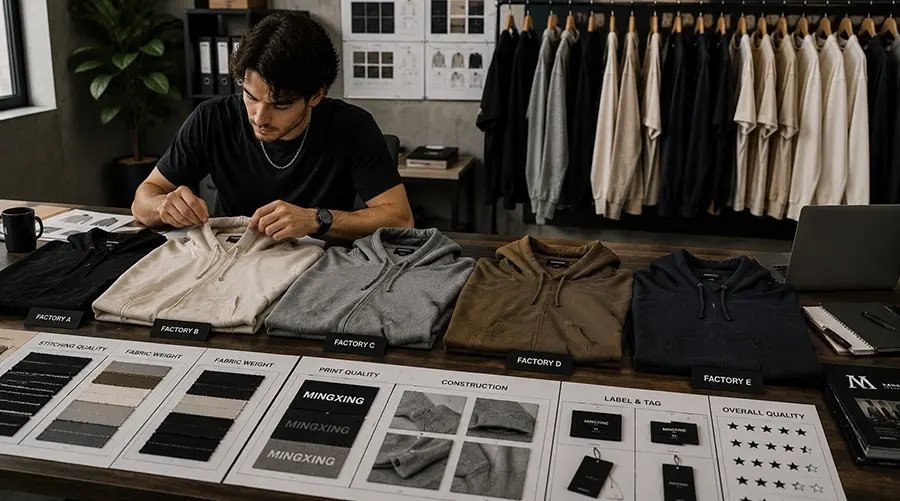
Compare Samples Side by Side
Samples often reveal more than quotations.
Instead of reviewing samples one at a time, place them side by side and compare them using the same criteria.
Sample Comparison Checklist
- Fabric feel
- Stitching consistency
- Measurements
- Print quality
- Embroidery quality
- Packaging
From a factory perspective, sample development is where many hidden problems become visible. Differences that seem small during sampling often become major issues during bulk production.
This is why experienced buyers rarely skip the sampling stage.
Compare Communication Quality
Communication is one of the most overlooked comparison factors.
Some factories reply quickly but provide little useful information.
Others may take slightly longer but ask detailed questions, identify risks, and offer practical solutions.
Ask Yourself
- Who responds clearly?
- Who understands your tech pack?
- Who asks relevant questions?
- Who identifies potential issues?
- Who offers solutions rather than excuses?
Many sourcing problems originate from communication failures rather than production failures.
A supplier that communicates well often prevents costly mistakes before they happen.
Compare Future Production Capability
Your current order may be 100 pieces.
Your next order could be 1,000 pieces.
That’s why comparing only today’s requirements can be risky.
Evaluate These Areas
- Production capacity
- Quality control systems
- Lead time stability
- Production scalability
- Project management capability
A factory that works for your first order should also be capable of supporting future growth.
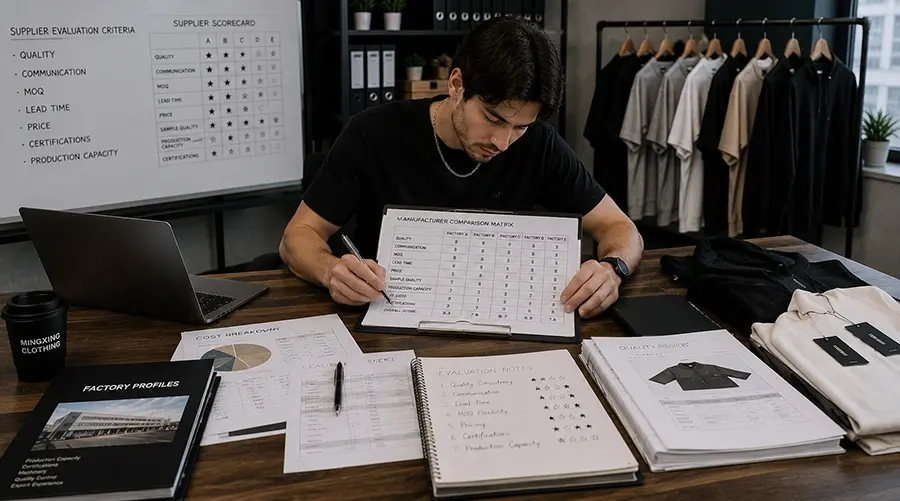
Manufacturer Comparison Matrix
This is the framework we recommend buyers use when comparing suppliers.
Manufacturer Evaluation Framework
| Factor | Importance | Why It Matters |
|---|---|---|
| Product Experience | ⭐⭐⭐⭐⭐ | Reduces development risk |
| Communication | ⭐⭐⭐⭐⭐ | Prevents costly mistakes |
| Sample Quality | ⭐⭐⭐⭐⭐ | Shows real capability |
| Quality Control | ⭐⭐⭐⭐ | Ensures consistency |
| Production Capacity | ⭐⭐⭐⭐ | Supports future growth |
| Price | ⭐⭐⭐ | Important but not decisive |
Factory Score Sheet
| Criteria | Factory A | Factory B | Factory C |
|---|---|---|---|
| Product Experience (/10) | |||
| Communication (/10) | |||
| Sample Quality (/10) | |||
| Quality Control (/10) | |||
| Production Capacity (/10) | |||
| Pricing (/10) | |||
| Total Score |
Using the same scorecard for every supplier makes the final decision much easier and more objective.
Final Comparison Checklist
Before making your final decision, make sure you have compared:
- Product experience
- Quotations
- Samples
- Communication quality
- Quality control systems
- Production capacity
- Long-term scalability
The goal isn’t to find the cheapest manufacturer.
The goal is to find the supplier most likely to deliver consistent quality, reliable communication, and long-term support.
If you’re currently evaluating factories for hoodies, T-shirts, jackets, tracksuits, or other apparel products, Contact Us to discuss your sourcing requirements and production goals.
FAQs
How many clothing manufacturers should I compare?
Most buyers should compare three to five manufacturers. This provides enough information to make a confident decision without creating unnecessary complexity.
Should I always choose the manufacturer with the lowest quote?
No. Lower prices sometimes come with compromises in quality, communication, or production systems.
How important are samples when comparing factories?
Samples are one of the most reliable ways to evaluate manufacturing capability. They often reveal differences that quotations cannot.
What if one factory has better pricing but worse communication?
In many cases, communication quality has a greater impact on project success than small pricing differences.
Can startups use the same comparison framework as larger brands?
Yes. The framework remains the same, although startups may place additional importance on MOQ flexibility and development support.
Share With
Related Articles



Hot Products